What is Brand Personality?
Brand personality refers to the set of human characteristics and traits associated with a brand. Think of it as giving your brand a human face. Just as people have distinct personalities that shape how they communicate and build relationships, brands too carry personality traits that define how they are seen and felt by consumers.
These traits can range from being playful and adventurous to serious and trustworthy. A budget airline might come across as no-nonsense and practical. A luxury watch brand, on the other hand, projects sophistication and heritage. Neither is better than the other. What matters is that the personality fits the brand’s promise and connects with the right audience.
Brand positioning strategy is an integral part of how a brand exists in the world. It influences the tone of every ad, the look of every visual, and even the way customer service conversations are handled.
Why Brand Personality Matters in Modern Branding?
To stand out among all the options available in today's marketplace, brands must use emotional branding to appeal to their customers' emotions.
The importance of brand personality strategy has only grown stronger in recent years. Research shows that 82% of consumers with high emotional engagement always buy from brands they trust, compared to just 38% of consumers with low emotional engagement. That is a significant gap, and it highlights how deeply emotional branding impacts purchasing behaviour.
Emotional branding is not about being dramatic or sentimental. It is about being relatable. When a brand speaks in a consistent voice, shows up with a clear point of view, and stands for something beyond its product category, people pay attention. They come back. They tell others.
A strong brand personality strategy also makes the brand positioning strategy far more effective. When you know who your brand is, it becomes easier to decide where it should appear, who it should speak to, and what story it should tell. Without a clear personality, even the best brand positioning strategy falls flat because there is nothing compelling at the centre of it.
The Key Elements That Shape a Strong Brand Personality
Building a recognizable brand personality does not happen by accident. It is the result of several deliberate choices made across communication, design, and culture.
Tone of Voice
Tone of voice is one of the most immediate expressions of a good brand personality strategy. Tone of voice decides whether your brand sounds warm and conversational or formal and authoritative. It tells the audience a great deal about what the brand values.
Visual Identity
Visual identity reinforces personality at a glance. Colour psychology plays a real role here. Research suggests that using specific colours strategically into a brand’s visual identity can improve a brand recognition by up to 80%.
Brand Behaviour
Brand behaviour matters just as much as messaging. How a brand responds to criticism, what causes it supports, and how it treats its customers all shape the importance of brand personality over time. Consumers today are particularly attentive to this. According to a Nielsen survey, 64% of consumers will purchase from a brand that shares their values.
Consistency
Companies that maintain consistency in their branding can experience a revenue increase of up to 23%. A brand that sounds cheerful in ads but robotic in emails, or looks premium on its website but sloppy on packaging, sends mixed signals. Over time, those mixed signals erode trust.
Understanding the Five Dimensions of Brand Personality
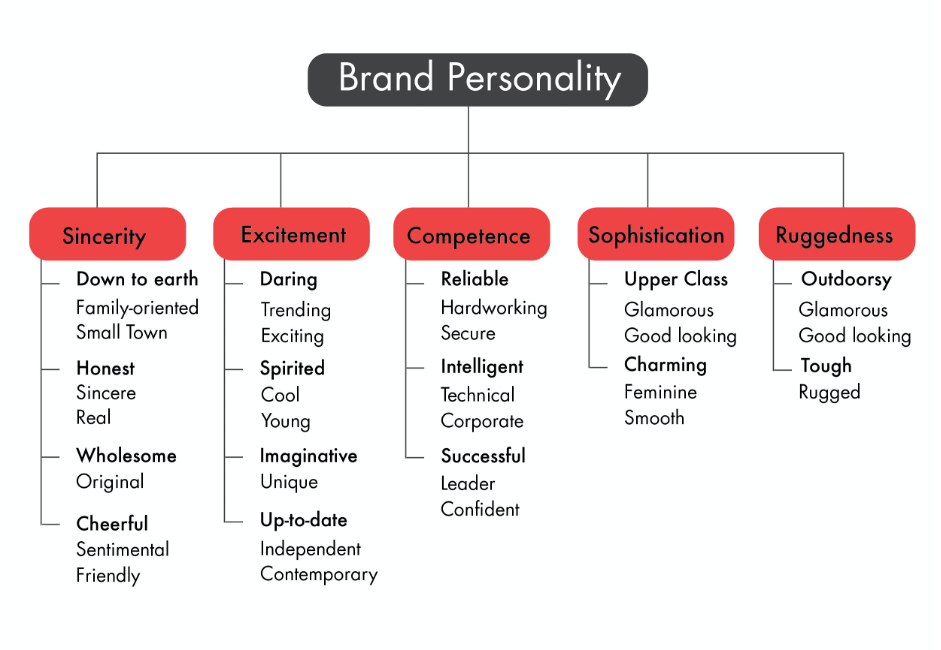
Jennifer Aaker identified five core dimensions of brand personality in her seminal work published in the Journal of Marketing Research. These five core dimensions have since become a widely used framework in brand strategy.
Sincerity
It describes brands that come across as honest, wholesome, and down-to-earth. Think of brands like Dove, which built its identity around real beauty and self-esteem.
Excitement
It captures brands that feel daring, spirited, and imaginative. Red Bull and Nike lean heavily into this dimension, consistently associating themselves with high energy and bold action.
Competence
Competence reflects reliability, intelligence, and success. Financial services companies and technology brands often anchor their brand personality strategy here, as these traits align with what consumers need to feel when making high-involvement decisions.
Sophistication
Sophistication is about glamour, charm, and upper-class associations. Luxury brands like Chanel and Rolex have mastered this dimension over decades.
Ruggedness
Ruggedness speaks to toughness, outdoorsy values, and strength. Brands like Jeep and Timberland use this dimension to connect with consumers who see themselves as resilient and independent.
Brand Personality vs Brand Identity: Understanding the Difference
These two terms are often used interchangeably, but they are not the same thing, and confusing them can lead to a weak brand identity strategy.
Brand Identity
It is the outward expression of a brand. It includes the logo, colour palette, typography, packaging, and other visual and verbal elements that make a brand recognizable. Brand identity is what a brand looks and sounds like.
Brand Personality
It is what a brand feels like. It is the emotional and human dimension that sits underneath all the visual choices. It answers the question: if this brand were a person, what would they be like?
To put it simply, brand identity is the costume. Brand personality is the character wearing it.
A strong brand identity strategy always starts with a clear understanding of brand personality. The visual choices a brand makes, the words it uses, the stories it tells, all of these should be a reflection of the personality that has been defined first. When the two are aligned, a brand feels cohesive and trustworthy. When they are not, something feels off, even if consumers cannot quite put their finger on why.
Examples of Strong Brand Personality Across Industries
Looking at real-world examples makes it easier to understand what a well-defined brand personality actually looks like in practice.
Apple
Apple has built one of the most consistent brand personalities in the world. Clean, minimal, and quietly confident, everything about Apple communicates that the brand values creativity and simplicity. Its brand positioning strategy has never been about being the cheapest option. It has always been about being the most thoughtful one.
Innocent Drinks
Innocent Drinks is a textbook example of a friendly and playful brand personality. From the copy on its packaging to its social media presence, everything sounds like it was written by a witty friend who cares about your health. That personality has helped Innocent stand out in a commodity-heavy category.
Harley-Davidson
Harley-Davidson is all about ruggedness and freedom. Its brand personality has created a near cult-like community of loyal riders who do not just buy a motorcycle. They buy into an identity.
Zomato
Zomato in India is a great regional example. The brand has built a sharp, irreverent, and often funny personality across its communication. That tone connects deeply with urban millennials who appreciate humour and relatability in a brand.
Common Mistakes Brands Make While Building Personality
Copying the competition
It is tempting to look at what the leading brand in your category is doing and mirror it. But brand personality only works when it helps you stand apart in a crowd. A thorough competitive communication audit is an essential first step to identify what space is already occupied and where the opportunity to differentiate lies.
Being inconsistent
A brand that sounds fun and casual on Instagram but stiff and corporate in its emails has a personality problem. Consumers notice this inconsistency even subconsciously, and it makes the brand feel unreliable.
Confusing aspiration with authenticity
Many brands project a personality they wish they had rather than one that is rooted in who they actually are. Consumers are sharp. They can tell when something feels forced or performative, and it backfires quickly.
Ignoring the consumer
A brand’s personality needs to connect with the people you are trying to reach. Understanding what your target audience is seeking, whether it is trust, warmth, status, or excitement, should shape every personality decision you make.
Treating personality as a one-time project
Brand personality is not a box you check during a rebrand. It needs to be lived every day, across every touchpoint, by everyone in the organization. The brands that do this well treat their personality as a compass, not a document.
FAQs
1. What is brand personality?
Brand personality is the set of human traits attributed to a brand. It shapes how consumers perceive and emotionally connect with it. It comes through in tone of voice, visuals, and behavior, making a brand feel approachable, trustworthy, bold, or sophisticated across every interaction.
2. Why is brand personality important for a business?
The importance of brand personality lies in turning transactions into emotional connections. It builds trust, encourages loyalty, and gives consumers a reason to keep choosing you. It also sharpens your marketing by giving every team a clear sense of how the brand should think, speak, and show up.
3. What are the five dimensions of brand personality?
Jennifer Aaker's five dimensions are sincerity (honest, genuine), excitement (energetic, daring), competence (reliable, expert), sophistication (premium, refined), and ruggedness (tough, outdoorsy). Most brands blend more than one dimension to build a brand identity strategy that feels layered and authentic rather than one-dimensional.
4. How does brand personality help a brand stand out from competitors?
When two brands offer similar products, a strong brand positioning strategy built on a distinct personality is what sets one apart. Personality gives consumers something to identify with beyond features and price, and unlike a logo or tagline, a genuine personality is very hard for competitors to replicate.
5. Is brand personality important for B2B businesses as well?
Emotional branding is just as relevant in B2B because buying decisions are made by people, not organizations. A brand that feels competent, transparent, and easy to work with earns more trust and referrals. In longer sales cycles, a clear personality can be the deciding factor.